Now Residency in Aomori Contemporary Art Center


Period of Stay: September 21 - November 30, 2012

Exhibition: November 3 - December 16, 2012

IT TAKES FOUR SORTS– CROSS-STRAIT-FOUR-REGION ARTISTIC EXCHANGE PROJECT

Taipei Fine Arts Museum, Taipei
Macau Old Court Building, Macau
Osage Gallery Kwun Tong, Hongkong
He Xianguing Art Museum, China

For“It Takes Four Sorts – Cross-Strait Four Region Artistic Exchange Project (2012)”, five curators of contemporary art from Taiwan, Mainland China, Hong Kong, and Macau have each selected three to four active young artists from a geographic region not the curators own to create separate exhibition units. Working from their own geographic and experiential specificities, the five curators made their selections and compromises with the concept of exchange as a starting point to created a four-unit exhibition representing the four regions that comprise the 2012 “Cross-Strait Four Region Artistic Exchange Project”. This marks the third year for the project which began in 2008 with “Departure”, followed by “Butterfly Effect” in 2009, and “1+1” in 2010. The artistic exchange project continues in 2012 will be held at the Taipei Fine Arts Museum for the first time. The ‘chimera’(四不像) in the Chinese title in 2012 refers to Père David's Deer. Known as milu in Chinese, the beast is also known by its nickname sibuxiang-- literally “unlike any of the four”— referring to the milu’s appearance of having the antlers of a deer but is not a deer, the face of a horse but not a horse, the tail of a donkey but not a donkey, and the hooves of a cow but not a cow. This is an apt metaphor for this exhibition of works from four regions across the China Strait, each with their own geopolitical differences as well as cultural and artistic contexts. The ‘chimera’ (四不像) becomes a concept for in-depth exchange, where five curators each observe the other in their geographical and contemporary artistic context. The understanding and friction that the exchange inevitably produces creates an opportunity for us to observe the ambiguities and differences that exist across the Strait and in the four regions.

photo at Macau Old Court Building

心動 EMU / Crush on EMU


Exhibition | Crush on EMU
Date | 2012/09/08-11/11
Venue |  MOCA Taipei
As computer technologies and Internet are rapidly advancing, not only our daily life has stepped into an era of digital application, a trend of hi-tech media and digital art has become prevailing since 1980. Facing this so-called third wave revolution of our civilization, an irresistible new wave, many Taiwanese contemporary artists, especially the new generation, have begun to explore new means amongst traditional media, such as that of the brushes, paper, canvases and paint. They submerge themselves in creative works of the new media art, employing computer programs, mouses and screens, and electro-kinetic devices as media. Meanwhile, the utilization of the digital images, video installations, screen projections, virtual spaces and platforms on the Internet, and the mechanism of hyper links has brought about new models for art exhibitions as well as the investigation into various possibilities of artistic creation and publicization.
“Crush on EMU” is co-curated by curators, Huang Chien-Hung and Chang Ching-Wen. While the title, EMU, uses the initials ofElectronic-Mobile-Ubiquitous to point out the change and formation of the three stages of the digital era, it also simultaneously corresponds to the French term, ému (as in “Je suis ému”), as an epitome of modern people’s reliance on the humanitarian environment and vision of the new digital technology. This exhibition includes 25 groups/28 contemporary Taiwanese artists, and they can be roughly divided into two types: (1) artists who specialize in digital media art, including Wang Jun-Jieh, Yuan Goang-Ming, Wu Chi-Tsung, Lin Guan-Ming, Wang Fujui, Tseng Yu-Chin, Yao Chung-Han, LuxuryLogico, Wu Chi-Yu, Chen Ching-Yuan, Yu Cheng-Ta, Hsieh Mu-Chi, Kuo I-Chen, Chang Ming-Yao, Li Cheng-Liang, Huang Po-Chih; and (2) artists who make use of non-digital media, including Chen Chun-Hao, Chen Shiau-Peng, Wang Sean, Tzeng Yong-Ning, Hsi Shih-Pin, Chou Tai-Chun, Tsai Home, Liao Chien-Chung, Huang Pei-Ying, whose works reflect the values and thinking, contemplations on trends, references of techniques or transformation of aesthetics of the digital era.
The curatorial logic and the placement of the artworks in this exhibition indicate an attempt to incorporate and convert the exhibition rooms and hallways into a corridor of time to stimulate trends reading as well art experience. The planning of the space and traffic flow intentionally juxtaposes characteristic artworks of digital art of the recent decade in Taiwan and the correlating, exemplifying art works created by artists outside the digital art circle. In this exhibition, viewers can conduct an on-site, intensive, multi-perspective reading of the embedded dialogues and subtle tensions between various parties ranging from the walled-in academia to the diverse and competitive art circle, and therefore, perceive and imagine a “consequent and continuous” surging relationship therein. 
photo/ MOCA Taipei

UPCOMING EXHIBITIONS


OURS.KARAOKE

OURS.KARAOKE - A Project by Yu Cheng-Ta


There are both the desires of "performing" and "seeing a performance" hidden deep inside us. The webcam and the system turns on the switch, allowing the Body to enter a visualized situation. Simultaneously, part of the Body is doing its best to perform, while the other part of it is gazing into the recorded self through the camera. In the project "OURS.KARAOKE," the artist Yu Cheng-Ta has invited his friends to join the performance: he has walked in his friends' places with a laptop, recording their Karaoke performance. The YouTube-like collected videos of those unrehearsed clips creates a show of desire which is beyond the songs being recorded.

Invisibleness is Visibleness International Contemporary Art Collection of a Salaryman- Daisuke Miyatsu


Exhibition Time:2011 / 7 / 9 ~ 2011 / 9 / 4
Exhibition Venue:台北當代藝術館 MOCA TAIPEI
Opening:2011 / 7 / 9 PM15:00

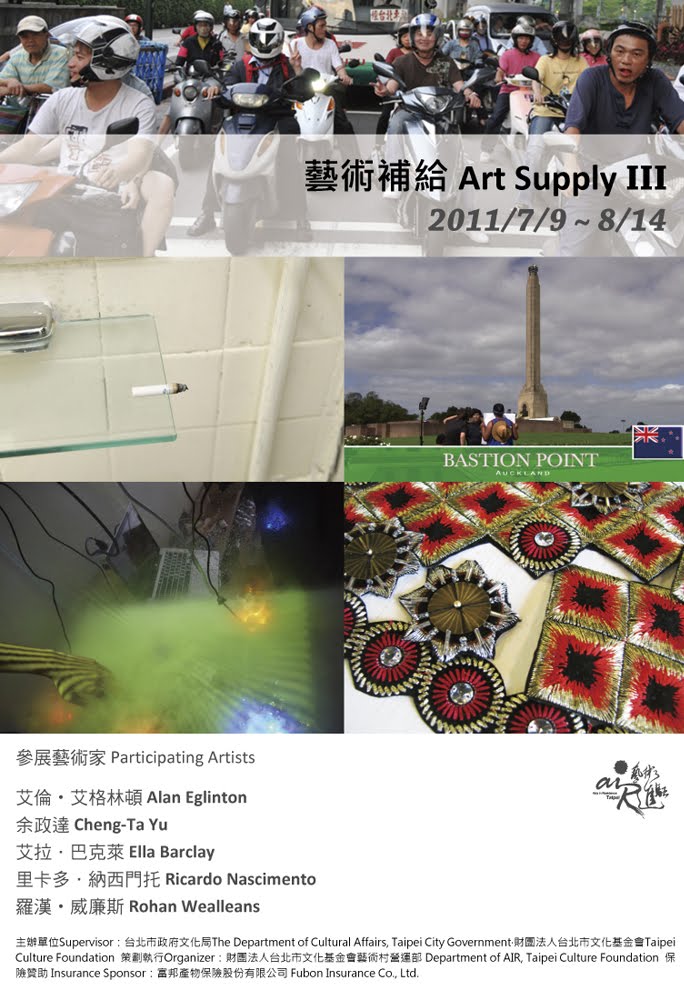
Art Supply III - Taipei Artist Village


藝術補給Art Supply III
展期Exhibition:2011/7/9 (六Sat.) ~ 8/14 (日Sun.)
台北國際藝術村開幕Opening at TAV:7/9 (六Sat.) 14:00
展覽地點Venue:台北國際藝術村百里廳Barry Room, Taipei Artist Village

參展藝術家Participated artist:余政達 Cheng-Ta Yu / 里卡多.納西門托 Ricardo Nascimento/ 羅漢‧威廉斯 Rohan Wealleans

Plug in X Add on: Taiwan Contemporary Art Exhibition

Rag Factory
16-18 Heneage Street, E1 5LJ (Tube: Aldgate East)
London, United Kingdom


"Plug in X Add on: a rehearsal of potential connections between two cities" Taiwan Contemporary Art Exhibition

"Plug in X Add on" offers the UK an exclusive look at the Taiwanese contemporary art scene, introducing young artists who were mostly born in the late ’70s and early ’80s, a time when Taiwan made the transition from manufacturing to high-tech industries.

"Plug in X Add on" is a concept that is inspired by computing practice, enabling third-party developers to transform and extend the function of host applications. Using such concept, the exhibition observes and experiments with the way young artists connect and adapt themselves to different cultures, societies and politics.

Participating artists:
Chang Ting-Tong
Chen Ching-Yao
Chen Ching-Yuan
Chu ChunTeng
Shih Yi-Shan
Su Yu-Hsien
Tsui Kuang-Yu
Yu Cheng-Ta

A Practice of City Guide: Auckland


As a tourist country, New Zealand has put much effort in the tourism industry, offering detailed tourist information and tours to promote its wonderful landscape. During the art village residence, Yu Cheng-Ta has transformed the tourist-like experience into his project "A Practice of City Guide: Auckland." In the work, Yu Cheng-Ta has made himself as a tourist guide. Just like those television hosts of the travel/adventure programs, Yu also adopts a foreigner's perspective to re-introduce the scenery of the country. The only difference is that he chooses a foreigner's language, through which he provides a discussion about the interplay of these cultures and the re-position of the characters. With such a rehearsal-like shooting style, Yu also re-constructs the relationship among the locations, the scenes, and the production team.

Exploding Taiwan


《爆破臺灣島》 Exploding Taiwan
余政達以影像為主要創作方式,先前的作品中藉由不同的媒體探討訊息扭異的現象,以2008年台北雙年展參展的《附身【聲】者》為例,他邀請外籍人士說仿別人躲在背後所說的中文語句,並藉由過程中不斷產生的陰錯陽差現象,突顯出在全球化、傳播化、互動化的時代,有關文化溝通、轉譯的諸般課題。

本次展出的影像作品《爆破臺灣島》,余政達以輕鬆的手法擬造了一個「微型媒體」。在201展室的帳篷裡秘密播放的影片中,匿名的受訪者正娓娓敘述著他們各自得到的第一手消息。每個人的說法各有落差,說明了此事本身資訊的不透明狀態,但也大抵指向某個共同的虛構文本:台灣的國家元首準備炸毀全島,並計劃邀請國際著名爆破藝術家跨刀相助,同時進行全球SNG連線直播,讓全世界看見這歷史性瘋狂的一刻。在全島埋設炸藥的兩年工期中,知情的台灣民眾四處尋求其他國家接收認養,至全島地沈消失的那天,台灣人民將四處散佈在全世界各國版圖。此作透過一種仿媒體傳播的「人云亦云」遊戲,讓民眾實地體驗了台灣作為幻見(fantasy) 對象的可能。

Exploding Taiwan
Yu Cheng-ta

Yu Cheng-ta uses images as his primary form of creation, with his previous works employing different media as mean to explore the phenomenon of message distortion. In his 2008 Taipei Biennial work Ventriloquists, the artist invited foreigners to repeat Chinese phrases spoken by people hiding behind them. This strange combination of circumstances brought many unpredicted mishaps, symbolizing the issues of cultural communication and translation under this era of globalization, transmission and interaction.

Present in this exhibition, Yu Cheng-ta creates through the video work Exploding Taiwan a “miniaturized media.” In every tent within exhibition room 201 a video is secretly played, each one with an anonymous interviewee describing in detail the first hand information they have obtained. There are discrepancies in the story of each person, explained perhaps by the confidentiality of the information itself. However, they all point to a common fictitious scenario: Taiwan’s head of state is getting prepared to blow up the entire island, and plans to invite world renowned demolition artist for assistance. The event would be broadcasted live globally, in order for the world to see this historical moment of madness. In the two years during which the project had been planting explosives across the nation, those who knew had sought asylum in other nations. On the day the island sinks and disappears, the Taiwanese people would be scattered across the nations of the world. The work imitates the “repeat what others are saying” game of the media, allowing the public to experience the possibility of Taiwan as an object of fantasy.

世界中的世界—余政達個展


Universes in Universe—a solo exhibition by Cheng-Ta YU


世界中的世界—余政達個展
2010. 08. 28 – 09. 26
Venue 新苑藝術 Galerie Grand Siècle


把玩著拼圖、嘗試辨認形狀的孩子,隨著成長,變成手持著抽象的知識拼圖,想要一塊塊拼湊出世界樣貌,對於「世界」的認識隨著成長逐漸累積,然而書本上截斷濃縮的歷史、簡化攤平的地理,本來就存在與真實間的距離,我們似乎總是透過自我的經驗來解讀世界、透過想像來編織經緯線,是圓是方,全賴個人主觀—或是自認為的客觀。

錄像藝術創作者余政達,2009年底赴紐約駐村,處在多元國族混合的異地,讓他重新思考關於「世界」與「自我」,展覽中他以隨機、輕鬆、互動的方式,拋去包袱,重現新意,游走於瑣碎與抽象之間,如一個人類學者般,企圖從微枝末節中求索一更為宏大的敘事方式。


As one grows up, the jigsaw puzzles he used to fiddle with in his hands are replaced by intangible scraps ofknowledge, based on which he tries to piece together what this world might look like. However, while Historyis condensed to fit chapters in a book, and Geography is flattened to compose pages of an atlas, are we reallygathering pictures which faithfully depict this world?

Video artist Cheng-ta Yu experiments the relations between culture, language and identity. His interest, however, does not lie in the conflicts between differences; instead, it is in the ambiguous fissures between differences. He takes approaches full of humor to connect and produce accidents, and thus, new possibilities of politics can be invented. Yu’s work has been exhibited in 2006 Taipei Biennial and won the grand prize of Taipei Arts Awards. In 2009, He was invited to exhibit at Contemporary Arts Center, Vilnius, Lithuania, and OK Center for Contemporary Art, Linz, Austria. Yu has also had a project in Taiwan Pavilion at the 53rd Venice Biennale in 2009.

形容詞舞蹈_余政達個展


當人們慣性使用的溝通字庫/動作,被經年的生活模式窄化後,新辭彙/姿勢的亮相或介入,往往重燃起我們對於表達行為本身的鮮奇感。那股仿說學唱的的熱情,乍現學齡兒時初與世界連線的滿足成就,這其中也同步寓意著,與他人之間因共驗而產生互相理解的安全感。

「形容詞舞蹈」將抽象的的形容文字,透過連續的肢體動作,轉譯成動態的符碼/舞碼,提供觀者解讀、學習模仿。配合節奏律動、穿插的字幕解說,我們同時閱讀到,人們對於某個抽象情緒所曾經產生的、普遍感受的交集,並另外觀賞或窺視到示範/表演者夾雜透露在舞蹈之中的私密反應。

「形容詞舞蹈」能夠在視覺上闡述語言底下的文字表情,這股詭趣的、“欲形容形容詞”般自作多情的動機,又再透過表演者詮釋出各自擁有的肢體表情,我們究竟是弄清楚了語言/符號能如何被使用來形容世界之下底上限,還是反而更疑猜表述者任何一個眉尾或關節中的潛台詞。

余政達選擇一種仿效教學影片的呈現方式,類似可被大眾消費購買的影像商品,或像可在自家按轉遙控器選看的教學頻道,作品內容即成為消費者期望社會化的進修媒介,變身語言補教的量販成品。不同的是,藉由表演者的再創作和肢體張力,即使是在余政達限定的遊戲框架之下:17個形容詞、一個八拍、1.5平方公尺範圍內,我們仍感暫時擺脫自身語言程度所限制的社會競爭力與溝通焦慮,重新斬獲交流的原始樂趣,甚至還有那幾分對於〝表達自由〞的熱切想望!

adj. Dance-a solo exhibition by YU Cheng-Ta


Exhibition Date/ 2010. 8.14-9.19
preview/ 2010. 8.14 / 15:00-18:00
Opening Reception/ 2010. 8.20 / 15:00-19:00


With our lifestyle gradually turning into a stereotype, such expression behaviors in the video always bring us a fresh feeling when the vocabularies / movements that we use habitually are interposed with new glossary / gestures. The ardent dance performance reminds us of a satisfaction emotion when we were first being involved to the world in our childhood. Meanwhile, it also delivers a great sense of security caused by mutual understanding between self and others due to the shared common experience.

transforms the abstract adjective vocabularies into a series of physical codes / dance movements, which allows audiences to interpret and imitate on their own. Through the regular rhythm and the alternate subtitle explanation in the video, we came to find ourselves sharing with the performers a common emotion toward a certain abstract sentiment. That is the hidden reaction when we saw performers attach their personal experience into the dances.

Yu Cheng-Ta tries to interpret linguistic literary vocabularies through the format of visual movements, which forms a very quaint and foolish representation of such series of “adjective-adjectival movements.” While watching performers use different movements to interpret each adjective, are we, through the dance, really understand how language codes are used for description? Or the dance contrarily leads us to question and guess the metaphor that the dance delivers.

is presented in the format similar to the dance teaching video, which seemingly to be one of those mass consumption product or self-learning programs on TV channel. The content thus becomes a language supplementary education product as well as a medium for consumers to learn socialization. However, within the game rules set by Yu Cheng-Ta such as the 17 adjectives / 2-measure tempo / 1.5 square meter area, we can somehow temporarily get rid of the communication anxiety or stress from the inadequacy in languages under the high social competition. Rather, we, for the short moment, can still re-embrace the pleasure of interaction to feely express ourselves.

BABEL


-Machon Hamayyim Gallery, Givatayim, Israel
-Curator: Orly Hoffman
-Artists: Cheng-Ta YU and Keren Yeala-Golan

Online Catalog

Universes in Universe I: World Map


Universes in Universe I : World Map from Cheng-Ta YU on Vimeo.


Universes in Universe is a video work, in which two girls from Asia reimagine and reconstruct a whole new world map. They communicate with each other in English, the only language they share, to decide where to locate different nations. In the process, the participants’individual experience mesh together and result in constant shifting of the pieces. Their judgement, in some ways, resonate with their embedded imagination of the “Others”. One usually preconceives the
world and reflects on oneself through his/ her own experience. Though maybe biased, it is also an interesting contrast with the real world.
Powered By Blogger